
The Speed Paradox: Why Amazon is Teaching Shoppers to Wait
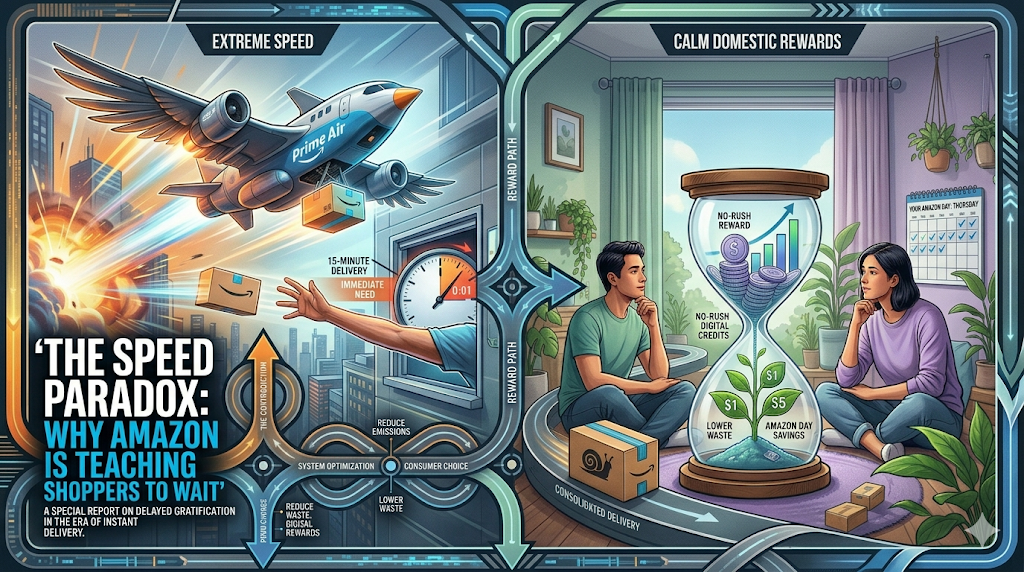
For the last decade, Amazon's primary value proposition was speed. "Next-Day Delivery" became the baseline, and "Same-Day" became the luxury. The company spent billions constructing a sprawling logistics network designed to eliminate the time delay between digital desire and physical ownership.
Yet, if you open the Amazon shopping app today, you will find a prominent new hub that completely rejects this philosophy.
Welcome to Amazon Haul—a dedicated, ultra-budget portal where prices are rock-bottom, products are shipped directly from manufacturers in China, and delivery times stretch from 1 to 2 weeks.
This is the great e-commerce speed paradox. At the exact same time Amazon is building out 30-minute micro-fulfillment hubs for everyday essentials, it is also training consumers to wait a fortnight for their fast-fashion, home goods, and tech accessories.
Here is an analysis of why Amazon is embracing "slow commerce," how the economics work, and what this strategic shift means for the future of the retail industry.
1. Deconstructing Amazon Haul: The "Dollar Store" Inside the App
Amazon Haul is a direct, defensive countermeasure against the meteoric rise of PDD Holdings' Temu, Shein, and TikTok Shop. These platforms captured massive global market share by connecting budget-conscious consumers directly to factories in China, bypassing domestic wholesalers and retailers to offer impossibly low prices.
Instead of fighting this trend, Amazon is replicating it.
The Core Constraints of Haul:
- The Price Ceiling: Every single item in the Haul feed is priced at $20 or less, with the vast majority of items sitting comfortably below the $10 mark.
- The Shipping Compromise: Free shipping is unlocked only on orders of $25 or more, but the real cost is time. Delivery takes between 7 to 14 days.
- The Protection Layer: Unlike its overseas rivals, which have faced intense scrutiny over counterfeit goods, unsafe materials, and difficult return processes, Amazon offers its standard A-to-Z Guarantee and free drop-off returns at over 10,000 U.S. locations (including FedEx Office).
By combining the dirt-cheap pricing of Chinese manufacturing with the safety and trust of the Amazon brand, Amazon is creating a compelling hybrid value proposition.
2. The Economics of Slow Commerce
To understand why Amazon is doing this, we must look at the mathematical trade-offs of modern e-commerce.
For a standard Amazon Prime order, the economics are heavily weighted toward fulfillment speed. Amazon must store inventory in local fulfillment centers, pick and pack individual items, and pay for premium, fast last-mile delivery. This structure requires higher average order values (AOVs) and healthy item margins to remain profitable.
By contrast, the direct-from-factory model operates on a completely different economic equation:
Value Proposition = (Convenience * Quality) / (Price * Wait Time)
When Price and Wait Time both scale down, the perceived value of the product can actually remain high for the consumer.
We can look at the contrast between these two fulfillment paths:
- Traditional Prime FBA: The product goes from the factory to sea freight, gets stored in a US warehouse, and is delivered to the home. The domestic fulfillment and premium shipping costs are high, but the delivery time is minimized to just 1 to 2 days.
- Amazon Haul Model: The product goes directly from the factory to air/line-haul transport, is handed off to a local postal carrier, and arrives at the home. Domestic warehousing costs are avoided, but the delivery time extends to 7 to 14 days.
By keeping inventory overseas until the moment of purchase, Amazon eliminates domestic warehousing costs, inventory holding risks, and premium shipping fees. Furthermore, these shipments often leverage the de minimis customs loophole (Section 321), which exempts shipments valued under $800 from traditional tariffs and duties, drastically lowering the cost of goods sold (COGS).
3. The Bifurcated Retail Strategy
The biggest risk of launching a budget, slow-shipping service is brand dilution. Why would consumers pay $139 per year for a Prime membership if they can get everything they need for $4 on Amazon Haul?
To prevent this, Amazon is executing a brilliant dual-brand strategy within its single application:
- The Time-Poor, Cash-Rich Shopper (Prime): Targets consumers who value convenience above all else. They need groceries in 30 minutes, a replacement charger tomorrow morning, and are willing to pay a premium for fast, reliable delivery.
- The Cash-Poor, Time-Rich Shopper (Haul): Targets Gen Z, bargain hunters, and impulse buyers who treat shopping as entertainment. They are happy to wait 10 days for a quirky phone case or a cheap sweater if it only costs them $3.50.
By segregating Haul into its own aesthetic experience—filled with vibrant colors, emoji-laden listings, and gamified discounts—Amazon successfully captures the "cheap thrill" market without eroding the premium expectation of its standard Prime services.
4. The Threat to Third-Party Sellers
While this is a masterclass in defensive corporate strategy, it presents a massive, existential crisis for traditional Amazon third-party (3P) sellers.
For years, the standard "Amazon FBA" playbook looked like this:
- Find a popular white-label product on Alibaba.
- Import it to a US-based Amazon fulfillment center.
- Optimize the listing, run Sponsored Ads, and sell it for a 3x markup to cover shipping, FBA fees, and advertising.
Amazon Haul completely breaks this model. When the exact same Chinese factories that supply FBA sellers can list their products directly on Amazon Haul for a fraction of the cost, the domestic middleman is entirely cut out of the loop.
To survive in this new paradigm, domestic 3P sellers must abandon cheap, generic commodities. They must focus instead on high-quality branding, proprietary product designs, and rapid, local shipping that Haul's 2-week delivery timeline simply cannot match.
Conclusion: Dominating the Entire Demand Curve
Amazon’s long-term goal has always been to capture 100% of consumer retail spend.
By building Amazon Now and Prime Air for the high-end, immediate-need market, and Amazon Haul for the ultra-cheap, delayed-gratification market, Amazon is effectively sandwiching the entire e-commerce sector.
Whether you need a physical item in 15 minutes or 15 days, Amazon is ensuring that you never have to close their app to get it.