
Amazon Is Building a Walmart-Sized Store. What a Joke.
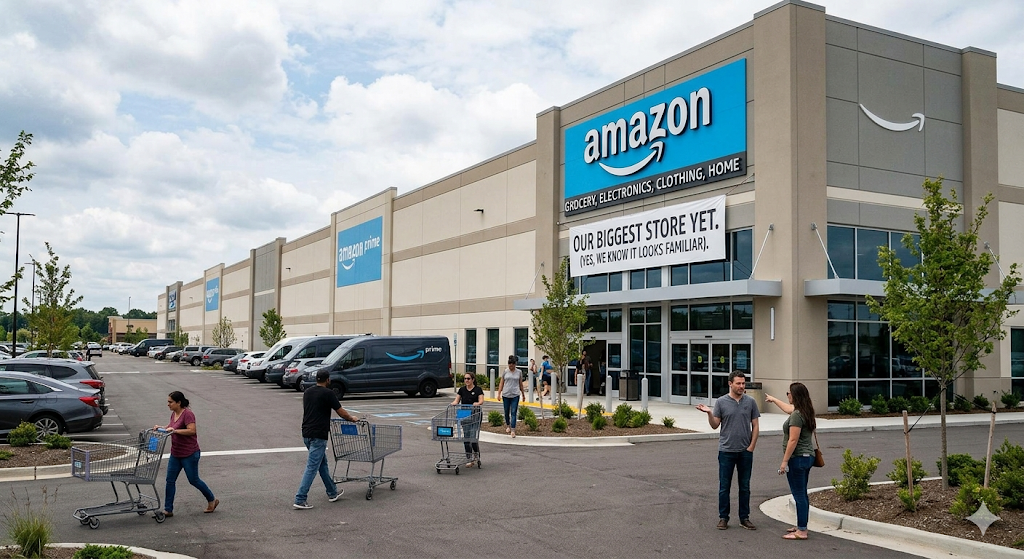
E-commerce is eating the physical world of retail. For the last 20 years or so, a host of historic department stores have gone out of business, the local mall has become a shadow of what it once was, and a host of brick-and-mortar retailers have struggled to get a website up and running to compete with the one-click purchase that e-commerce made possible.
At the center of this seismic shift in retail is Amazon, the e-commerce retail leader. For two decades, Amazon has worked to revolutionize the way in which people shop for things online and now offline as well.
As e-commerce continues to evolve and penetrate the physical retail market more and more, it seems quite contradictory that the world’s largest online retailer is opening a store. Not only is this store going to be huge, 230,000 square feet, large enough that two average Target stores would fit in this single retail space, but it is actually bigger than the average Walmart Supercenter of approximately 179,000 square feet. The world’s e-commerce king of retail, the retailer that built its company making sure that customers never had to leave their house to shop, is building a huge physical store.
But what is behind this unprecedented expansion into a space it dominated for so long? And what can this tell us about the future of retail, one of the biggest industries of all time?
Inside the Megastore: Half Aisles, Half Fulfillment
This is not going to be another 4-Star store (super-sized yes, but same format as others). According to Amazon this will be a first for them, the first of a new kind of retail store that blends the best of in-store shopping with some very innovative technology that enables a very fast and convenient online picking up experience as well.
About half of the space will be devoted to what Amazon calls a ‘conventional’ retail store. In this area of some 115,000 square feet there will be wide aisles of around 6 to 7.5 feet but half as wide as usual down the center of the store for packed-in, wall-to-wall shelves of products. All sorts of products can be found here, including fresh produce, meat, dairy, deli products, as well as prepared foods. Also, there will be a large number of household items and general merchandise typical of a large store.
The 50/50 Split: The other half of the space will be a back-of-house automated giant fulfillment center. This is where the 'pick and pack' will occur for all of the online orders.
As a customer walks through the aisles of merchandise, they will be able to scan the bar code on the products of interest to them, and the item(s) will be added to their online retail order. Once they have completed selecting all of the items they want to purchase online, the customer proceeds to the retail checkout where they can pay for their online order and have all of their items retrieved from the automated fulfillment center and prepared for pickup. Shoppers can use their smartphones to search for products as they shop the store and add them to their online retail order as well.
While large purchases such as heavy bags of pet food or large quantities of paper products can be a challenge for consumers, they can be picked up at the drive-up bays where customers receive automated packages placed in their automobiles.
No Prime Required: This store is intended to reach the broadest possible customer base. That is to say, there is no Prime required to shop or to pay for your goods here.
As I described in my previous post regarding Amazon’s Fulfillment Strategy, last-mile logistics is the single most expensive part of e-commerce for most companies. Amazon will fulfill same-day online orders within the new store’s local delivery area (perhaps a half-dozen zip codes). And, of course, Amazon shoppers can now pick up their online orders (large or heavy) at the new store as well.
The Dual-Front War: Megastores vs. 30-Minute Delivery
I advise you to read my recent post explaining Amazon’s new emergency delivery service they are creating called ‘Amazon Now’ to understand the differences between the new megastore and the other physical shopping services they will be providing. You can find it by clicking here.
The Backlash in the Backyard
The new megastore, actively in construction in Orland Park, IL, is receiving much push back from the local residents in the area because the store was approved quite fast. Many believe the traffic from the new store, which is situated right next to a 165,000 Sq. Ft. Costco, will be far too much.
And while it is obvious to most now that Amazon’s digital model has already forced physical stores out of business - boutiques, specialty stores, mom and pop stores, etc., many believe Amazon will enter into the physical retail space to drive out whatever remaining brick and mortar competitors there are left. As one local resident posted on social media recently, summarizing the bitter irony of the situation: “They put retailers out of business just to open a retail store.”
The Bottom Line
For years, Walmart has tried to solve the ‘online problem’ by purchasing failed online retailers and building out their own e-commerce platform. Now, Amazon is trying to solve the ‘physical problem’ in a similar fashion that Walmart tried to solve the ‘online problem’.
Will this end up being a place that people have to go to in order to buy their daily essentials or will they order it online and have it brought to their front door? The store will be so large that it will be a serious rival to the largest Walmart locations. It will be right next to the local Costco, and I have a feeling that it will not be long before the battle for where and how people can buy their daily essentials is transferred to the suburbs in a physical form rather than just on the screen of your smartphone.
So will Amazon’s new retail stores be a hit with shoppers?